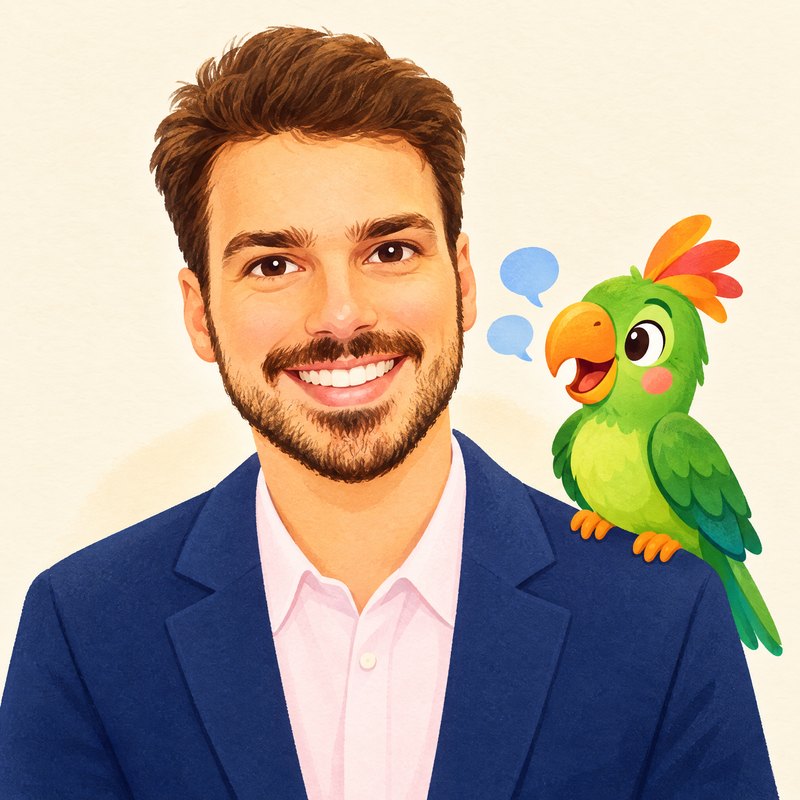
Why I built PepeLingo
Built by a physician for his children’s language journey.
I built PepeLingo so my children can appreciate their heritage and grow up able to talk with family in Greek and Spanish, not just recognize a few words.
Children who start young tend to pick up a language’s sounds more naturally, so I wanted something that works before they can read: a funny parrot who talks with them every day, and a clear view for me of what they can actually say.
 Dr. Alex AntoniouPhysician, founder, and dad

Meet Pepe
A funny, patient friend, not a flashcard.
Pepe is curious, a little dramatic, and very fond of mangoes. Children don’t open a lesson. They go and talk to Pepe.
Short and silly
Pepe talks in tiny lines, shows before explaining, and sometimes an apple lands on Pepe’s head.
Never says “wrong”
Close answers get “Almost! Listen…” and a warm replay. Nobody fails with Pepe.
Gets things wrong on purpose
“Is that a gato?” Pointing at a dog. Your child gets to correct the parrot.
Talks more of the new language over time
As your child understands more, Pepe speaks more of the new language. Pepe never switches because of a timer.
The journey
From first words to real conversation.
Every stop is built from the stops before it. Nothing new appears until your child can use what came first.
- Stop 1
First 50 words
“Mamá. Agua. Perro.”
The most common words first, each one shown in a picture and said by Pepe. Your child points and says it back, then names familiar people and things and asks for more.
- Stop 2
Core 100
“¿Quieres agua?” “¿Quieres un perro?”
The sentence shapes families use all day, with a slot your child fills from the words they already know. One pattern, many sentences: two-word phrases for wants, people and play.
- Checkpoint
Songs and cartoon videos
Made only from the words learned so far.
Between stops, a short sing-along uses nothing but what your child already knows, so they understand every line. Short cartoon films at the end of a stage are made the same way.
- Songs
- Cartoon videos
- Stop 3
Core 250
Short sentences about the here and now.
More everyday words and more patterns to put them in, still only from what came before.
- Stop 4
Core 500
Asks and answers simple questions.
Questions, answers and the words around them, so a child can take part in a short back-and-forth.
- The destination
Core 1,000: everyday conversation
Using the most common words and phrases.
Age-appropriate talk about familiar things, at a child’s level. From there, kids’ shows in that language, trips, and time with family keep it growing.
The goal is Conversational: everyday conversations about familiar things, at a child’s level. Levels move only when your child shows new abilities, never for time spent or streaks.
Languages
A curriculum built from native speakers.
Every sentence pattern Pepe teaches starts from how real parents talk to their toddlers: measured in recordings of English- and Spanish-speaking families, and shaped for Greek by native speakers. Not a textbook, and not a translation of one.
¡Hola!
Spanish
Everyday Latin American Spanish, the way families in Mexico and across the Americas talk to their little ones.
Γεια σου!
Greek
Modern Greek as spoken in Greece today, with the small words a yiayia uses at the table.
Hello!
English
For children whose home language is Spanish or Greek, the same way around.
أهلاً!
Arabic
Arabic is next on Pepe’s list. It is not available in the app yet.
- Coming soon
Meet Pepe today.
Free to start: the first 3 stages in any language, no card and no trial clock. Pay only if Pepe becomes part of your days.