The science behind Pepe
Fewer words, more conversation.
PepeLingo is based on research about how young children learn languages. Here is what it says, honestly, and how we use it.
Start early
Children who start hearing and speaking a language young tend to pick up its sounds more naturally. On average, the earlier the start, the more native-like the accent. It changes gradually with age; there is no single cutoff.
The most useful words first
In everyday conversation, a few thousand of the most common words make up about 95% of what people say. Pepe starts with the most frequent, most useful words, so each new word shows up again and again in real sentences.
Familiar words first, then more of the new language
Children learn best from language they can mostly understand, and they learn more of a language the more they hear it. Pepe starts by mixing new words into a language your child already knows, then speaks more and more in the new language as your child is ready.
Two languages, one growing brain
Brain-imaging studies find differences in brain structure in people who use two languages, especially those who learned early. Claims that bilingual children are “smarter” or better at focusing are debated, and large reviews find small or no effects. We build PepeLingo for connection with family and heritage, not for test scores.
References
- Flege, J. E., Munro, M. J., & MacKay, I. R. A. (1995). Factors affecting strength of perceived foreign accent in a second language. Journal of the Acoustical Society of America, 97(5), 3125–3134. doi.org/10.1121/1.413041
- Abrahamsson, N., & Hyltenstam, K. (2009). Age of onset and nativelikeness in a second language: Listener perception versus linguistic scrutiny. Language Learning, 59(2), 249–306. doi.org/10.1111/j.1467-9922.2009.00507.x
- Adolphs, S., & Schmitt, N. (2003). Lexical coverage of spoken discourse. Applied Linguistics, 24(4), 425–438. doi.org/10.1093/applin/24.4.425
- Nation, I. S. P. (2006). How large a vocabulary is needed for reading and listening? Canadian Modern Language Review, 63(1), 59–82. doi.org/10.3138/cmlr.63.1.59
- Dale, P. S., & Fenson, L. (1996). Lexical development norms for young children. Behavior Research Methods, Instruments, & Computers, 28(1), 125–127. doi.org/10.3758/BF03203646
- Krashen, S. D. (1982). Principles and Practice in Second Language Acquisition. Pergamon. www.sdkrashen.com/content/books/principles_and_practice.pdf
- Hoff, E., Core, C., Place, S., Rumiche, R., Señor, M., & Parra, M. (2012). Dual language exposure and early bilingual development. Journal of Child Language, 39(1), 1–27. doi.org/10.1017/S0305000910000759
- Place, S., & Hoff, E. (2011). Properties of dual language exposure that influence 2-year-olds’ bilingual proficiency. Child Development, 82(6), 1834–1849. doi.org/10.1111/j.1467-8624.2011.01660.x
- Mechelli, A., et al. (2004). Structural plasticity in the bilingual brain. Nature, 431, 757. doi.org/10.1038/431757a
- Bialystok, E., Craik, F. I. M., & Luk, G. (2012). Bilingualism: Consequences for mind and brain. Trends in Cognitive Sciences, 16(4), 240–250. doi.org/10.1016/j.tics.2012.03.001
- Lehtonen, M., et al. (2018). Is bilingualism associated with enhanced executive functioning in adults? A meta-analytic review. Psychological Bulletin, 144(4), 394–425. doi.org/10.1037/bul0000142
- Gunnerud, H. L., et al. (2020). Is bilingualism related to a cognitive advantage in children? A systematic review and meta-analysis. Psychological Bulletin, 146(12), 1059–1083. doi.org/10.1037/bul0000301
How children really learn
Talking first, then reading.
No child learns their first language from a page. They talk for years, then learn to read the words they already say. PepeLingo follows the same order: the speaking path now, and in spring 2027 an early-readers path that teaches the same words again, in letters, once your child is talking comfortably.
- Now · Talking
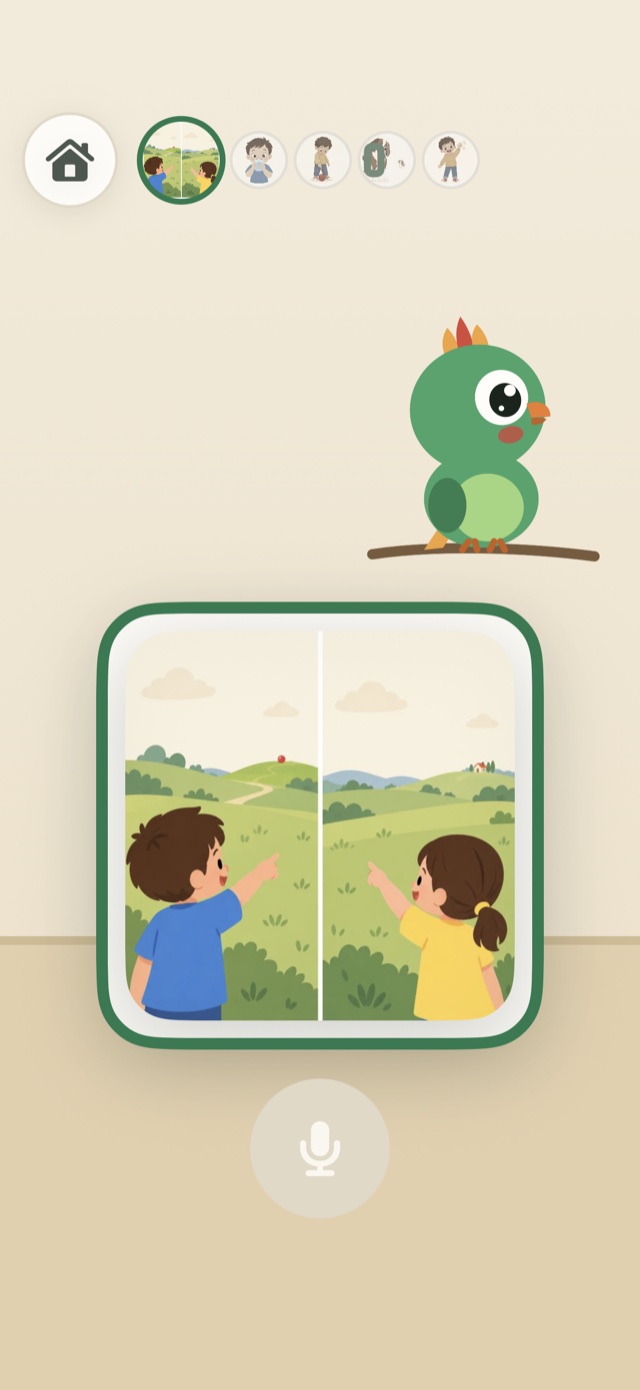
Hear it, see it, say it.
Pepe says perro, the dog appears, and your child says it back. Words return in new scenes and new sentences until they stick, and the parent area shows which ones have.
- Spring 2027 · Reading
Then the same words, in letters.
The early-readers path opens after the speaking path. Your child meets the words they already say and understand, now written down, so reading starts from meaning instead of memorizing.
- Coming spring 2027

Meet Pepe today.
Free to start: the first 3 stages in any language, no card and no trial clock. Pay only if Pepe becomes part of your days.